Why Inspection Companies Are Transitioning from Film RT to Digital Radiography
Film radiography has been trusted in nondestructive testing for decades. It works. Inspectors know it. Procedures are built around it.
So why are more inspection companies investing in digital radiography?
The answer is bigger than image quality.
Inspection companies are looking at the entire cost and workflow of radiographic testing. Film, chemicals, processing, storage, labor, repeat exposures, travel, setup time, and project delays all affect what an inspection actually costs.
Digital radiography changes that equation.
It requires a larger investment upfront, but it can remove many of the recurring costs and delays built into traditional film radiography.
For inspection companies running enough RT work, the question is becoming less about whether digital radiography works and more about when the investment begins to make financial sense.
Want to compare the numbers for your operation? Use our RT vs. DR Cost Calculator →
Table of Contents
Film RT Is Still Proven Technology
It is important to start here.
Film radiography is not suddenly obsolete.
It remains a proven inspection method, and there are applications, procedures, customer requirements, geometries, and operating environments where film continues to make sense.
The problem is not that film stopped working.
The economics and expectations around inspection have changed.
Inspection companies are under pressure to complete more work, provide results faster, control labor costs, maintain traceable records, and reduce unnecessary downtime.
That is where digital radiography starts to look different.
Instead of asking:
“Is digital better than film?”
A more useful question is:
“What does each method cost us per inspection, and what does that look like over hundreds or thousands of exposures?”
That is the conversation driving the transition.
Why Inspection Companies Are Moving Toward Digital Radiography
Direct digital radiography replaces radiographic film with a digital detector. After exposure, the resulting image can be evaluated electronically rather than waiting for film to be chemically processed.
Digital radiographic techniques for weld inspection are well established. ISO 17636-2 specifically covers X-ray and gamma-ray testing of welded joints using digital detectors, including computed radiography and digital detector arrays.
The technology itself is no longer the only story.
The bigger change is what happens around the inspection.
1. Film Creates a Recurring Cost
Every film exposure consumes something.
There is the film itself, but that is only part of the cost.
Depending on the operation, traditional film radiography can also involve:
- Film
- Processing chemicals
- Darkroom equipment
- Film storage
- Cassettes and screens
- Processing labor
- Waste handling
- Physical archiving
Those expenses continue for as long as the company continues shooting film.
Digital radiography changes the cost structure.
The detector represents a much larger upfront investment, but it is reusable. There is no new sheet of film to purchase for every exposure and no film development process afterward.
For a company performing a limited amount of RT, that distinction may not justify the capital investment.
For a company performing hundreds or thousands of exposures, it becomes much more important.
2. Processing Time Affects Inspection Throughput
Inspection companies do not make money developing film.
They make money completing inspections.
With film RT, an exposure is only part of the process. The film still needs to be processed before the inspector can evaluate the image.
Digital radiography compresses that workflow because the image becomes available electronically.
That can mean:
- Faster image evaluation
- Faster acceptance decisions
- Less waiting between inspection stages
- Quicker identification of exposure problems
- More inspections completed during the same working period
The value becomes especially noticeable when inspection volume increases.
Saving a few minutes on one exposure may not sound significant.
Multiply that across 50, 100, or 500 exposures and the economics change.
3. Immediate Image Review Changes the Workflow
One of the most practical differences between film and digital radiography is feedback.
With DR, technicians can review the captured image without waiting for film development.
That matters when something needs to be corrected.
If positioning, exposure, geometry, or another factor needs attention, the team can identify the issue much sooner.
With traditional film, that feedback loop takes longer.
For inspection companies, faster feedback can mean less time spent discovering problems after equipment has already been repositioned or the inspection team has moved on.
This does not mean DR automatically eliminates retakes. Technique, equipment, procedures, detector selection, geometry, and technician experience still matter.
It simply gives the team information sooner.
And in field inspection, time matters.
4. Digital Records Are Easier to Store and Share
Film requires physical storage.
Digital images can become part of a digital inspection record.
That changes what happens after the exposure.
Images can be organized, retrieved, transferred, reviewed, and archived electronically based on the company’s procedures and customer requirements.
For inspection companies serving customers across multiple facilities or geographic locations, that can simplify collaboration.
An engineer does not necessarily need access to a physical piece of film to review an image.
The inspection record can also become easier to integrate with the rest of a digital reporting workflow.
As asset owners increasingly expect accessible and traceable inspection data, that advantage becomes harder to ignore.
5. The Economics Improve as Inspection Volume Increases
This is where the decision gets interesting.
Film can have a lower barrier to entry.
Digital radiography usually has a higher upfront cost.
But upfront cost and total cost are not the same thing.
Consider two inspection companies.
Company A performs occasional radiographic inspections.
Company B performs RT every day across multiple crews.
The economics of switching to DR may look completely different for those two companies.
Company B repeatedly pays for film, processing, handling, storage, and the labor associated with that workflow.
A digital system shifts more of that expense toward the initial equipment investment.
Eventually, the avoided recurring costs can begin offsetting the upfront investment.
The important number is therefore not simply:
“How much does a DR system cost?”
It is:
“How much are we currently spending to continue using film?”
6. Digital Radiography Creates Opportunities for Automation
Replacing film with a digital detector is one step.
Changing how that detector is deployed can be the next.
Pipe inspection is a good example.
A technician may need to reposition a detector repeatedly around a pipe to capture the required exposures. The efficiency of the overall inspection therefore depends on more than the detector.
Positioning matters.
Repeatability matters.
Setup time matters.
Panel handling matters.
ScanTech’s approach to digital radiography focuses on this part of the workflow.
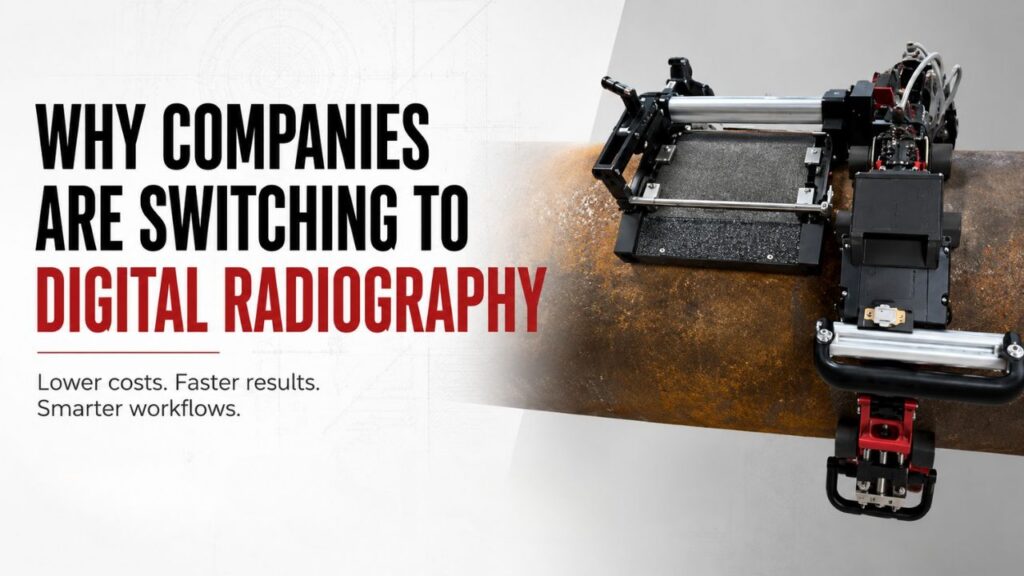
The CLIX DR platform supports controlled detector positioning around pipe, while XtenDR is designed to support and protect bendable DR panels while maintaining controlled curvature.
XtenDR is not a detector. It is a purpose-built panel support system designed to help manage how a flexible DR panel conforms to the pipe and reduce unnecessary bending stress on a high-value detector.
Together, mechanical positioning and digital imaging can help inspection teams rethink the entire RT workflow rather than simply replacing film with a panel.
Related: Learn how Digital Radiography is changing pipeline weld inspection →
What Does It Actually Cost to Switch?
There is no honest universal answer.
The cost of transitioning to DR can include:
- Digital detector
- Computer hardware
- Imaging software
- Training
- Procedure development or qualification
- Detector positioning equipment
- Protective equipment
- Workflow changes
- Maintenance
- Detector replacement over its service life
That is the argument against looking only at the benefits of DR.
A detector can be expensive.
Damage to a detector can also be expensive.
A company that performs very little radiography may have a much longer payback period than a high-volume inspection company.
This is why the transition should be evaluated as an investment rather than simply an equipment purchase.
Run the Numbers Before You Buy
Our RT vs. DR Cost Calculator lets inspection companies compare their existing film workflow against a potential digital workflow.
Enter the variables that matter to your company and estimate where the transition may begin paying for itself.
Use the RT vs. DR Cost Calculator →
Film RT vs. Digital Radiography
|
Consideration |
Film RT |
Digital Radiography |
|
Initial equipment investment |
Generally lower |
Generally higher |
|
Film required |
Yes |
No |
|
Chemical processing |
Yes |
No |
|
Image availability |
After processing |
Near immediate |
|
Image enhancement |
Limited |
Digital tools available |
|
Storage |
Physical archive |
Digital archive |
|
Sharing |
Physical or digitized |
Electronic |
|
Recurring consumables |
Higher |
Reduced |
|
Detector reuse |
N/A |
Yes |
|
Detector damage risk |
N/A |
Important cost consideration |
|
Automation potential |
Possible |
Strong fit for digital workflows |
|
Best financial fit |
Depends on application |
Often improves with higher volume |
There is no winner in every row because there is no inspection technology that is best for every job.
The right choice depends on the work.
When Does Digital Radiography Make Sense?
DR deserves serious consideration when an inspection company:
- Performs a high volume of RT work
- Has significant annual film and processing expenses
- Needs faster image turnaround
- Frequently shares inspection data between locations
- Wants to reduce physical archive requirements
- Needs faster feedback in the field
- Is investing in digital reporting
- Wants to automate detector positioning
- Can generate enough inspection volume to justify the capital investment
The higher the inspection volume, the more important the cost calculation becomes.
That is why a company shooting thousands of exposures per year should probably evaluate DR differently than a company performing occasional RT jobs.
The Transition Does Not Have to Happen Overnight
Moving toward digital radiography does not require declaring film dead.
Inspection companies can evaluate DR where it makes the most operational and financial sense.
Start with the work.
Look at:
- Annual film consumption
- Processing costs
- Labor involved in film handling
- Average exposures per job
- Retake rates
- Inspection turnaround time
- Storage requirements
- Current customer requirements
- DR equipment investment
- Expected inspection volume over the next several years
Then compare the two workflows.
That creates a much stronger business case than simply buying new technology because the industry is moving digital.
Calculate Your Potential RT vs. DR Cost Difference →
Frequently Asked Questions
Why are NDT companies switching from film to digital radiography?
Is digital radiography cheaper than film RT?
Does digital radiography completely replace film?
How quickly can a company recover the cost of a DR system?
Can digital radiography be used for pipe weld inspection?
What is the difference between DR and CR?
What equipment does ScanTech offer for digital radiography?
The Real Question Is What Your Current Workflow Is Costing You
Film RT still works.
That’s not the issue.
The issue is whether continuing to buy film, process it, handle it, store it, and wait for results remains the most efficient option for the amount of inspection work your company performs.
For some inspection companies, the answer will still be yes.
For others, the numbers may show that the transition to digital should have started already.
Don’t guess.
Run your own numbers.
Compare Film RT vs. Digital Radiography Costs →
See how film costs, inspection volume, labor, and equipment investment can change the long-term economics of your radiography program.