Table of Contents
How Digital Radiography Is Changing Pipeline Weld Inspection
Pipeline radiography has relied on film for decades. It’s a proven inspection method, but the way radiographic images are captured, processed, and reviewed is changing.
Digital radiography (DR) gives NDT teams another option.
Instead of exposing film and waiting for chemical processing, a digital detector captures the radiographic image electronically. The result is faster access to inspection data and a workflow that can be better suited for today’s field environment.
For pipeline inspection teams, however, changing the detector is only part of the equation. The equipment used to position that detector around the pipe can have just as much impact on the inspection process.
What Is Digital Radiography in NDT?
Digital radiography is a form of radiographic testing that uses a digital detector instead of traditional radiographic film.
After an exposure, the detector converts the received radiation into a digital image that can be viewed and evaluated on a computer.
This eliminates several steps associated with traditional film processing and allows inspection teams to access images much sooner.
For pipeline weld inspection, DR can help create a more streamlined process from image capture through evaluation and documentation.
Film Radiography vs. Digital Radiography
Traditional film radiography requires more than the exposure itself.
Film must be handled, processed, developed, reviewed, stored, and replaced with additional film for future inspections.
Digital radiography changes that workflow.
Images are captured electronically, allowing technicians to review inspection data without developing film. Digital files can also be stored, transferred, and retrieved without maintaining a physical film archive.
The benefits can become significant when an inspection requires a large number of exposures.
But there is another part of the process that shouldn’t be overlooked: positioning the detector.
The Challenge of Positioning DR Panels on Pipe
Pipeline inspection requires the detector to be positioned correctly relative to the weld and radiation source.
When multiple exposures are required around the circumference of a pipe, manually moving and repositioning a DR panel can add time to the inspection.
It can also introduce another variable into the process.
A positioning system designed specifically around the pipe can help create more controlled and repeatable detector movement.
That’s where automated DR scanning systems come into the picture.
Automated Digital Radiography for Pipeline Inspection
Automation can extend the advantages of digital radiography beyond image capture.
Rather than manually repositioning a detector between exposures, an automated positioning system can move the DR panel around the pipe in a controlled manner.
This can help reduce equipment handling between exposures while creating a more repeatable inspection workflow.
How CLIX DR Automates Panel Positioning
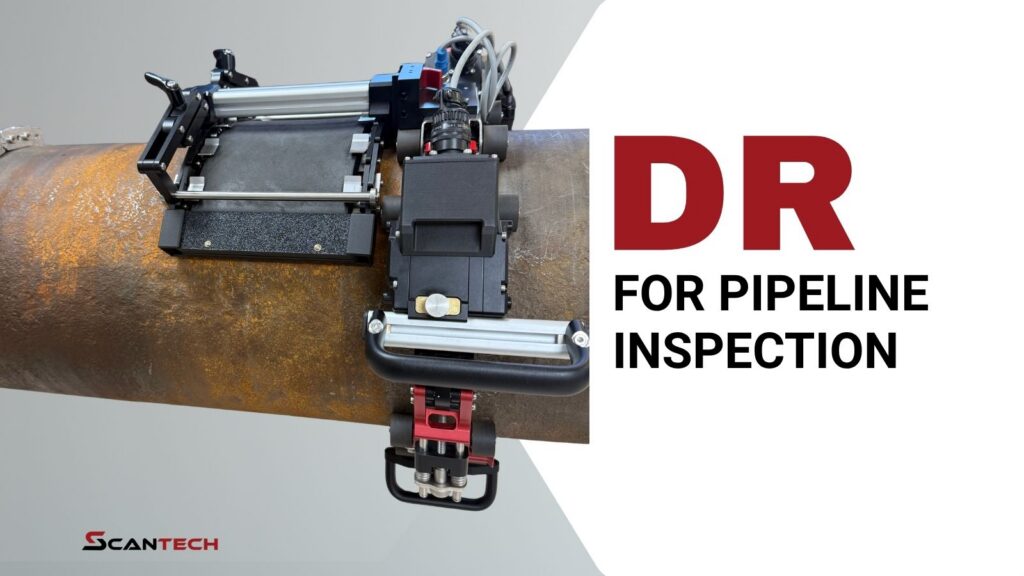
ScanTech developed CLIX DR to combine digital radiography with a modular scanner designed specifically for pipe.
Rather than treating the DR panel as a separate piece of equipment that must continually be repositioned by hand, CLIX creates a platform around the pipe for controlled detector positioning.
The modular chain design allows the scanner to adapt to different pipe diameters while maintaining a compact field configuration.
With the Automated Wireless RT configuration, technicians can control movement remotely and reposition the detector for the next exposure.
The goal is simple: spend less time handling equipment between exposures and create a more repeatable inspection workflow.
XtenDR Adjustable DR Panel Holder
A DR scanner is only useful if it works with the equipment an inspection company already uses.
That’s why CLIX DR uses the XtenDR adjustable DR panel holder.
XtenDR is designed to accommodate virtually any DR panel, giving inspection companies greater flexibility when selecting or using digital detectors.
Instead of building the scanner around one detector manufacturer, the system is designed around the inspection.
This also gives companies more freedom to upgrade or change DR technology without necessarily replacing the positioning platform.
Digital Radiography Equipment Built for Field Inspection
Pipeline inspections don’t happen in controlled laboratory environments. Equipment has to work where the pipe is.
CLIX DR was designed with that reality in mind.
Key system features include:
- Automated wireless positioning for radiographic inspection
- Modular chain configuration for different pipe diameters
- XtenDR adjustable DR panel holder
- Compatibility with ferrous and non-ferrous pipe
- High payload capability for larger DR panels
- Battery-powered operation
- Up to 8 hours of controller runtime
- Integrated emergency stop
The result is a DR positioning platform built around actual field inspection requirements.
Why Automation Matters in Digital Radiography
Moving from film to digital radiography can improve the image acquisition workflow, but automation can take that transition another step.
Automated detector positioning can reduce the amount of manual handling required between exposures and make it easier to move the panel to the next inspection position.
For inspection companies evaluating DR, that means the conversation shouldn’t only be about which detector to purchase.
The complete workflow matters.
Questions to Consider When Evaluating a DR System
Before investing in a digital radiography system, inspection teams should consider:
- How will the DR panel be positioned?
- How often will it need to be moved?
- How much time is spent setting up each exposure?
- Can existing DR equipment work with the positioning system?
- Can the system adapt to different pipe sizes?
- Can the positioning equipment adapt as inspection requirements change?
Those questions can have a major impact on the practical value of a digital radiography investment.
Moving From Film to a Digital Radiography Workflow
Replacing film with a digital detector is an important change, but digital radiography creates an opportunity to rethink the entire inspection process.
Automation, remote positioning, modular equipment, and flexible detector compatibility can all contribute to a more efficient field workflow.
CLIX DR was built around that idea.
Digital imaging shouldn’t just replace film. It should improve how the inspection gets done.
See CLIX DR in Action
Interested in seeing how automated digital radiography can fit into an existing pipeline inspection workflow?