Table of Contents
We use the X3 Spider when we need repeatable, encoded tank wall B-scans instead of broad full-area corrosion maps. For API 653-style shell work, its closed-loop control, magnetic pull force, AC-or-battery flexibility, and B-scan-focused workflow help us capture cleaner data and support faster reporting.
Why repeatability matters in tank wall inspection
When we inspect storage tanks, we are not just trying to collect a few numbers and move on. We are trying to build a data set that supports thickness assessment, condition review, corrosion-rate thinking, and reporting that can stand up to owner, inspector, and management scrutiny. Our own API 653 setup guidance explains that documented thickness measurements, condition assessments, and remaining-life or corrosion-rate calculations are central to code-oriented tank workflows, while official API materials describe API 653 as the standard tied to tank inspection, repair, alteration, and reconstruction for aboveground storage tanks.
That is also why ultrasonic testing remains such a practical fit for tank wall work. Official ultrasonic testing guidance says UT is commonly used to measure thickness and detect internal defects, including in energy and petrochemical settings where corrosion and wall loss matter every day. In other words, the question is rarely whether UT works. The real question is whether the scanning method gives us repeatable enough data to trust when we compare one job, one drop, or one inspection interval to the next.
We also write this from a company point of view for a reason. Our company history says we started as NDT technicians who wanted to change how ultrasonic scanning was performed, and that background shows up in how we think about field tools. We want scanners that make better inspection decisions easier, not prettier marketing claims easier.
Why the X3 is the tool we feature for this job
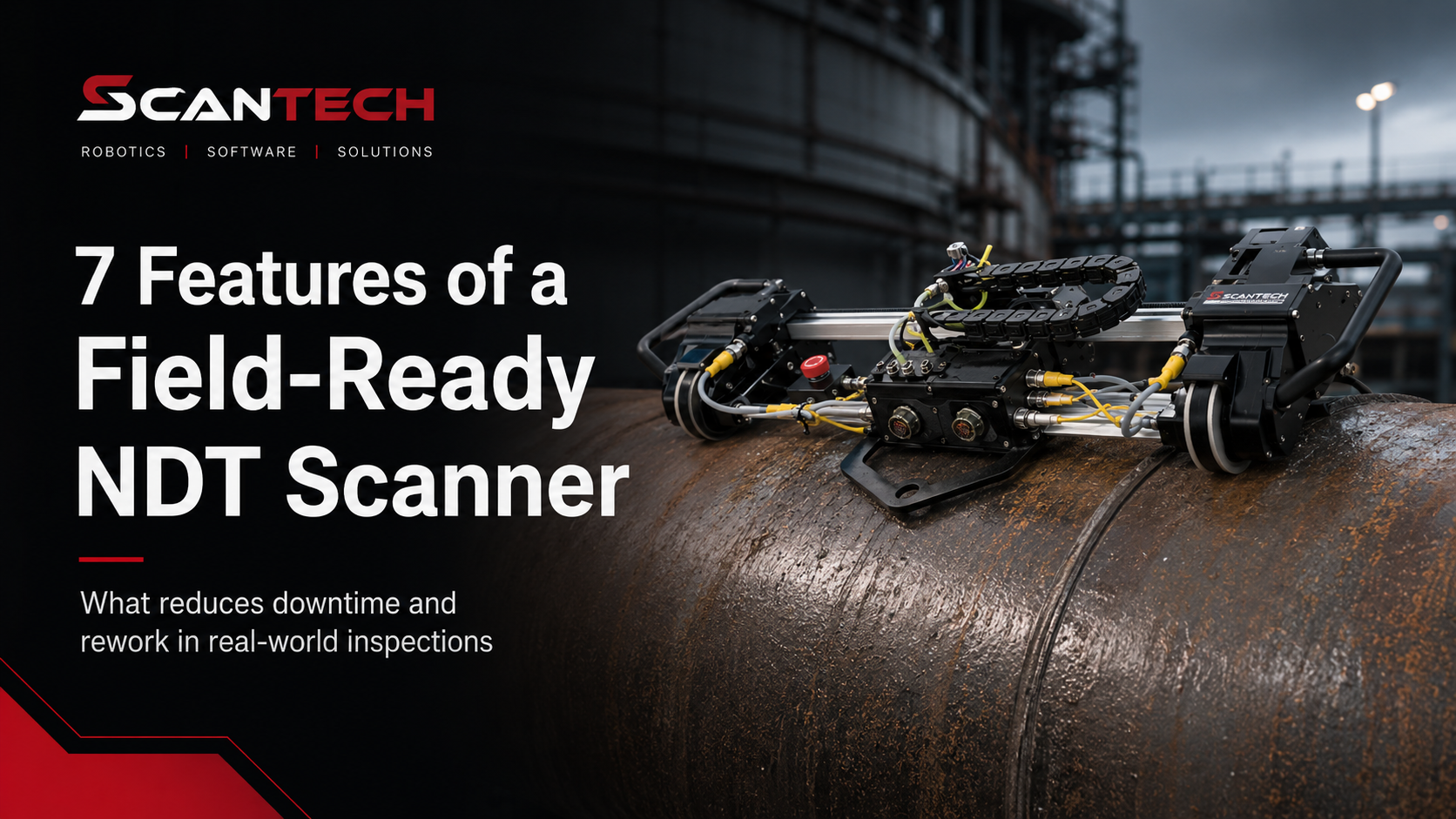
The X3 Spider is positioned on our site as a B-scanner platform built for demanding ultrasonic inspections. The product page highlights billet 6061 aluminum and 303 stainless steel construction, a proprietary direct-drive gear set, rare-earth motors, single- and dual-element transducer options, closed-loop control with a magnetic encoder, and AC or battery power. It also lists 60 lb of magnetic pull force per wheel, 240 lb total, plus 109 lb of tractive pull and 11 in./sec speed under cable load.
Those details matter because tank wall work rewards control. We want stable adhesion on steel, predictable motion, consistent probe contact, and a scanning platform that does not introduce extra variability into the data. The same product page also highlights a sealed design, high-compliance suspension, and a probe-coupling design intended to reduce turbulence and water use while maintaining near-constant contact force. That is the kind of field language we care about because it connects directly to scan quality.
How we think about B-scan versus corrosion mapping
We do not present the X3 as the answer to every tank question. Our own B-scan-versus-corrosion-mapping article makes a clear distinction: for API 653 tank wall work, B-scanning is the primary method for assessing wall thickness and material loss through linear drops, while corrosion mapping is better for full-surface raster imaging on floors and other large areas. That same page specifically positions the X3 Spider as our premier semi-automated scanner for B-scan drops and ties Analyst X software to API 653 reporting.
That distinction is important for ranking content too. Searchers do not just ask, “What is the X3?” They ask, “When should we use a B-scan crawler instead of corrosion mapping?” They ask, “What is the best scanner for tank wall B-scans?” They ask, “Is automated tank wall scanning worth it over manual UT?” This blog is built to answer those questions clearly because those are exactly the kinds of questions AI search systems extract from structured pages.
How we typically run the workflow
We define the inspection question first
Before we deploy anything, we decide what the job really needs. If the objective is repeatable shell-thickness B-scan drops, the X3 workflow makes sense. If the objective is broad area inspection or high-density surface visualization, we shift into a wider tank inspection strategy and choose the tooling accordingly. That is exactly how our own B-scan and tank-inspection content frames the decision.
We do the basic UT work correctly
Even the best crawler does not rescue a poor UT setup. Official BINDT guidance explains that ultrasonic thickness gauging is based on pulse-echo travel time and requires calibration or knowledge of the correct material velocity. Our tank-inspection best-practices content adds the field version of that guidance: keep coupling consistent, clean the surface, match probe frequency to wall thickness, and verify the thickness reading before moving into production scanning.
We use encoded motion instead of relying on hand movement
This is where the X3 creates value. Our manual-versus-automated UT comparison explains that manual repeatability depends heavily on the operator, while automated systems improve movement consistency, data sampling, archival traceability, and downstream comparison. That matters a great deal on tank walls, where we want to compare structured data instead of debating whether a technician’s hand speed, angle, or pressure changed the result.
We care about the report as much as the scan
A crawler is not the end of the workflow. The scan has to become a usable record. Our B-scan article says Analyst X is designed for B-scan data and can automate API 653 reporting, while our API 653 setup article emphasizes position encoding, measured thickness data, and documentation strong enough to support corrosion-rate and remaining-life work. We keep coming back to the X3 because it helps us get from field acquisition to defensible output with less friction.
FAQs
Is the X3 Spider a good fit for API 653 tank wall inspection?
Yes. Our B-scan guidance positions B-scanning as the primary method for API 653-style tank wall thickness evaluation and specifically identifies the X3 Spider as our semi-automated scanner for B-scan drops.
Why would we choose the X3 over manual hand scanning?
We choose it when repeatability, encoded movement, and cleaner datasets matter more than fastest setup. Our own comparison page says automated UT improves repeatability, reduces operator variability, and creates stronger traceable records than manual hand scanning.
When should we use corrosion mapping instead of the X3?
We switch when the inspection question becomes full-area surface visualization rather than linear shell-thickness drops. Our B-scan-versus-corrosion-mapping page makes that distinction clearly and treats the two workflows as related but not interchangeable.
If you want us to help size the right workflow for your next tank job, contact us.