Principle of Ultrasonic Testing
Ultrasonic Testing (UT) is one of the most widely used methods in non-destructive testing (NDT). It relies on high-frequency sound waves—typically between 0.5 and 25 MHz—to detect flaws, measure thickness, and evaluate material properties without damaging the component.
The principle is straightforward: a transducer sends ultrasonic pulses into a material, and when those waves encounter a boundary (like a crack or inclusion), some of the sound is reflected back. These reflections are captured and displayed as signals that reveal the depth, size, and shape of internal discontinuities.
The accuracy of UT depends on several factors:
- The frequency and type of probe (single, dual, or phased array) used
- The angle and coupling between the probe and the surface
- The material density and geometry
For example, dual element probes help reduce near-surface “dead zones,” while phased array probes can electronically steer and focus the beam for advanced imaging applications.
(Learn more about probe configurations in Single vs Dual vs Phased Array Probes).
Types of Ultrasonic Testing Methods
Different ultrasonic techniques are used depending on the inspection goal and component geometry:
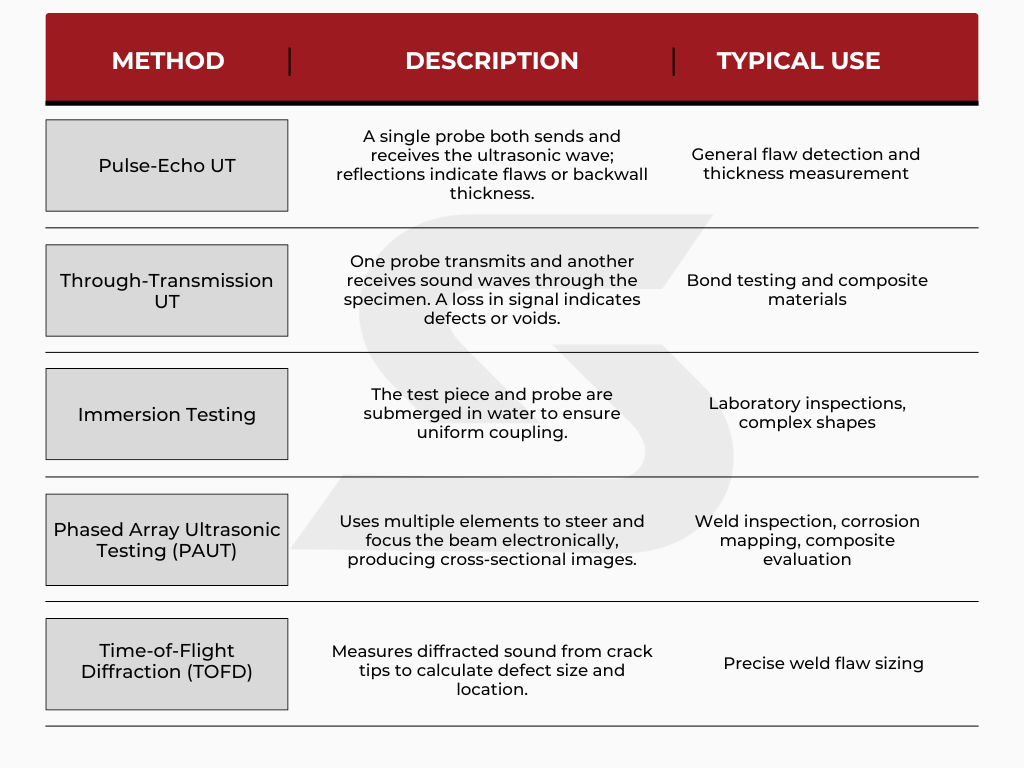
These techniques align with ASTM E114 and E1065 standards, which outline procedures for probe evaluation and ultrasonic data acquisition.
Applications by Industry
Ultrasonic testing is valued across industries that require accuracy, speed, and safety in material evaluation.
Oil & Gas
Used for pipeline corrosion mapping, weld inspection, and tank wall monitoring—helping operators comply with API 653 and ASME B31G standards.
Power Generation
Critical for inspecting turbines, boilers, and pressure vessels to prevent catastrophic failures caused by fatigue or thinning.
Aerospace
Essential for detecting delaminations, inclusions, and cracks in lightweight composite or metallic components.
Manufacturing
Applied in quality assurance to check weld integrity, casting porosity, or bonding quality before shipment.
Pulp & Paper
Ensures dryer rolls and near-drum surfaces remain structurally sound, preventing costly production downtime.
Marine & Shipbuilding
Monitors hull thickness and internal corrosion to maintain seaworthiness and safety.
Pros and Limitations of Ultrasonic Testing
Advantages
- High sensitivity to internal and subsurface flaws
- Instant results with digital readouts
- Portable and versatile equipment options
- Depth measurement accuracy in metals, plastics, and composites
- Safe and clean, using only water or gel as couplant
Limitations
- Requires skilled operators to interpret data
- Difficult to inspect rough, irregular, or coated surfaces without proper coupling
- Material geometry may cause signal scattering or loss
- Limited for materials with large grain structures, such as cast iron
How to Choose UT Over Other NDT Methods
UT is not always the only—or even the best—option. Choosing the right inspection method depends on several key factors: