Table of Contents
What to Compare Before Selecting a System
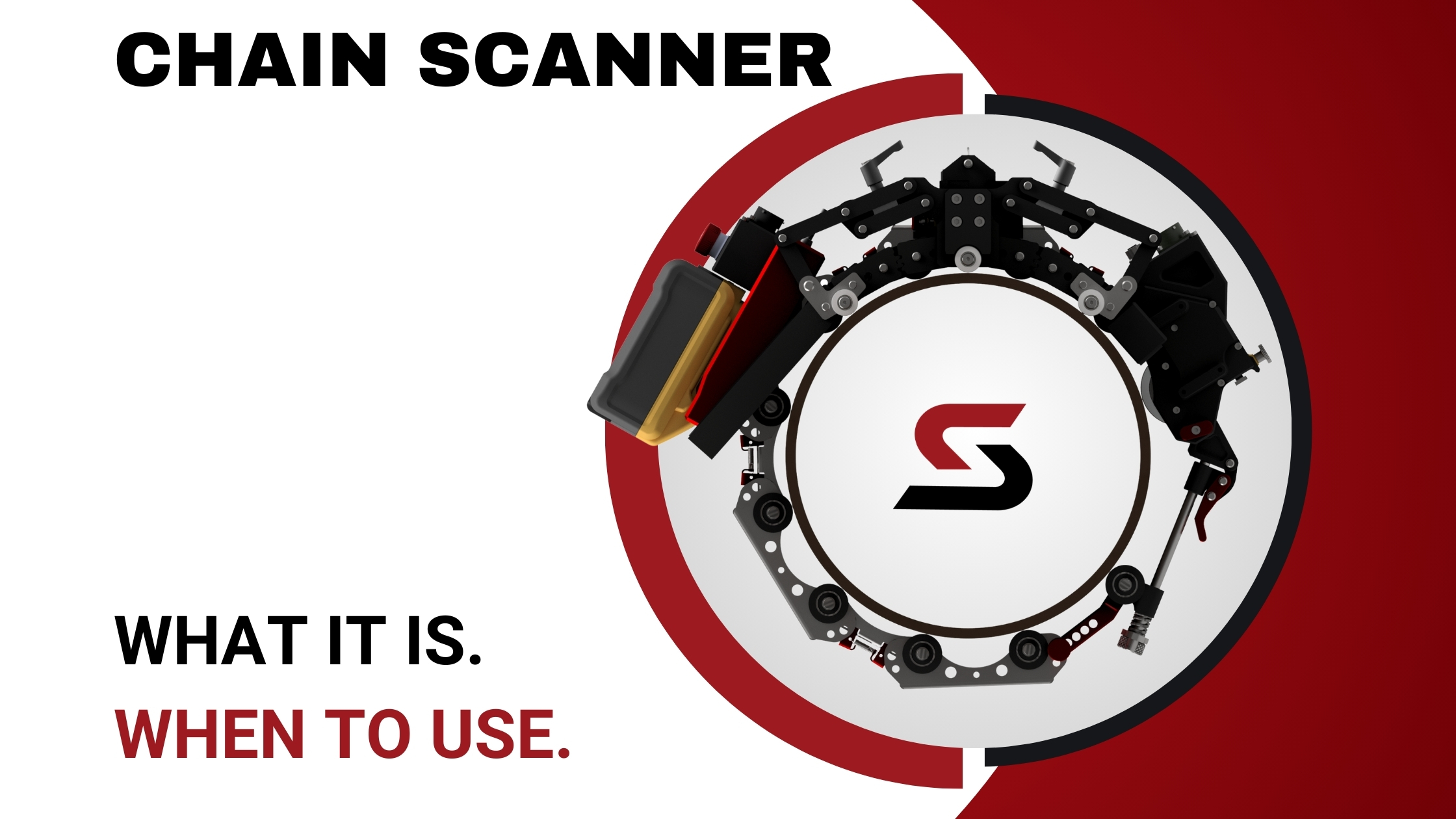
Searching “chain scanner” often means the same thing: a system is needed that can wrap a range of pipe sizes, carry the required inspection method, and produce repeatable results without causing delays in setup or reporting. Two chain scanners can look similar but perform very differently once field conditions, payload weight, and workflow requirements are involved.
This guide outlines the highest-impact comparison criteria—focused on what changes inspection outcomes, not what looks good on a spec sheet.
Related pages: pipe inspection solutions
Step 1: Define the inspection method and reporting requirement
Start with the inspection method and what the report must prove.
- Weld inspection workflows often prioritize stable alignment and repeatable indexing.
- Corrosion workflows prioritize repeatable coverage and controlled scan paths.
If reporting needs fast turnaround, add scan planning early using a tool like a scan time estimator.
Step 2: Compare chain scanner capability using field-relevant criteria
1) Diameter range and modularity
A chain scanner should match today’s pipe sizes and the next project’s sizes without complicated add-ons. Modular link systems make diameter changes more straightforward.
2) Tensioning and latch reliability
A secure latch/clasp design affects repeatability. If chain tension changes mid-scan, results change too.
3) Payload capacity
Payload capacity matters when mounting heavier inspection setups or accessories. Under-rated payloads tend to create drift, misalignment, or unstable tracking.
4) Motion control options
Manual, motorized, and wireless configurations each fit different realities:
- Manual can be sufficient for shorter or simpler scans
- Motorized adds consistency for longer or higher-precision workflows
- Wireless supports workflows where cables create restrictions or safety challenges
5) Surface compatibility
Field surfaces vary—coatings, scale, corrosion, curvature, and material type can change how stable the scanner stays.
6) Repeatability features
Look for features that support repeatability and documentation:
- indexing consistency
- alignment aids
- stable mounting
- consistent travel around the circumference
Common mistakes when selecting a chain scanner
- Buying only for pipe diameter and ignoring payload stability
- Underestimating latch/tension design (repeatability suffers first)
- Assuming motion control is optional in long or high-precision workflows
- Skipping scan planning, leading to unrealistic timelines and rushed execution
Compare chain scanners with real project parameters.
Use the scan time estimator to calculate scan duration, then book a demo to review pipe diameter, inspection method, and configuration options.
FAQs
How is a chain scanner different from a band scanner?
A chain scanner uses linked segments that are modular across diameters; a band scanner uses a continuous band that may limit modular changes.
Does a chain scanner work for corrosion mapping?
Yes—chain scanners are often used for corrosion mapping workflows where controlled, repeatable travel helps maintain consistent coverage.
When does motorized motion matter most?
Motorized motion matters most in longer scans, higher repeatability requirements, and workflows where consistent speed reduces variability.